“A Place for Everyone”: Hispanic Heritage Month Reflections with Sofie Ramirez Soto
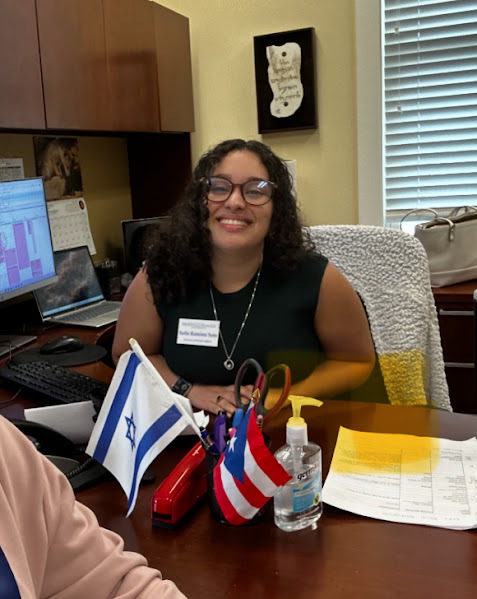
From mid-September to mid-October, Hispanic Heritage Month invites communities across the United States to honor the histories, cultures, and contributions of Hispanic and Latino Americans. At Hillel, it’s also an opportunity to highlight the diverse identities and stories that make up today’s Jewish student life.
This year, we spoke with Sofie Ramirez Soto, Jewish life program director at Washington and Lee Hillel and co-chair of Hillel International’s Jews of Color (JOC) employee resource group (ERG). Sofie shared how her heritage and her experience as a Jewish Latina have shaped her leadership, and why creating spaces of belonging for all Jewish students remains at the heart of her work.
How has your experience as a Jewish Latina impacted your Jewish journey and leadership?
It’s taken me a long time to feel confident in my Jewish identity, and I’m very happy to be at that point now. When I was young, I was badly bullied by my Hebrew-school classmates for being different. Later, in high school and college, I was often bombarded with questions about my legitimacy, whether I had a “right” to be in certain Jewish spaces or leadership roles.
This is the start of my third year working for Hillel, and I can truly say it has been a healing experience for me. There were certainly growing pains and learning moments, but the community at NYU Hillel [where I was a Springboard Fellow] is very open. They were able to see me in my entirety and create an uplifting space, not just for me, but for the JOC student community at NYU. Now, as the director of a small Hillel, and the co-chair of the Hillel International Jews of Color employee resource group, I have not only the confidence to be myself, but to lead others. I am truly grateful to the movement for that, and I hope we continue to uplift diverse voices.
How did your experience as a Jew of Color inspire you to create spaces of belonging on campus?
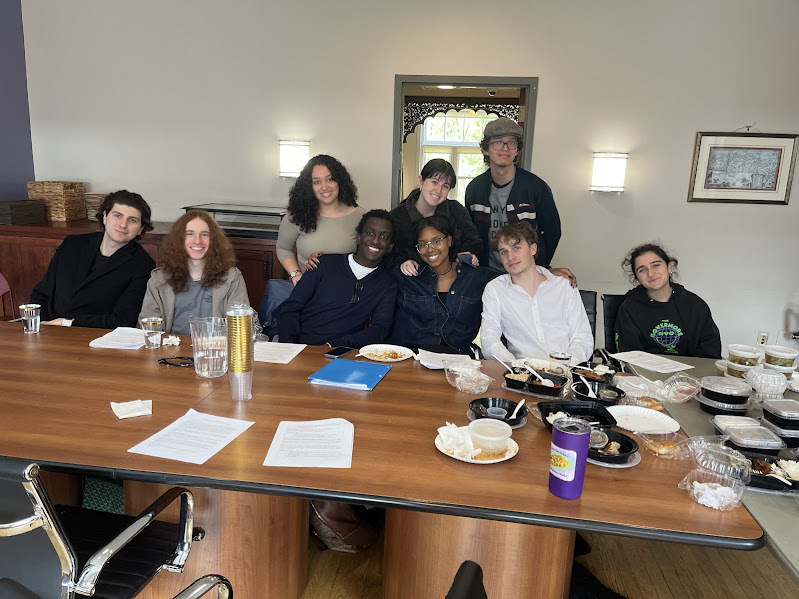
I’m a big believer in being the person your younger self may have needed, and I’ve been lucky to work with such a diverse student population that could genuinely benefit from that space. Some of the interns I was placed in charge of in my first year were Jews of Color, and they were interested in helping me create this community. I really could not have done it without them. Enthusiasm creates enthusiasm, and soon students who were not previously involved started attending my events, and some even felt called to step up to formal leadership. I think that, hands down, was the most rewarding aspect of my work.
You helped launch Makom LeKulam (A Place for All) at NYU Hillel. What was that process like, and how did it lead to your work with the JOC ERG?
At first the group was just called “JOCs,” then we expanded to “JOC-SM” to include our population of Sephardi and Mizrahi students. It was really difficult trying to create programs that represented the many diverse sub-communities existing at NYU, especially for communities that I was not a part of and had little knowledge of. And that is the exact reason why it is so important.
The idea for Makom LeKulam, a place for everyone, came from our Jewish Agency Israel Fellow, Lielle, who comes from a Moroccan background and was a huge help in the programming when she joined our team. It made me realize that I didn’t have to pick and choose which culture to uplift and teach in any given program.
Thanks to that shift, we were able to start several smaller groups, including Judios Latinos (encompassing our Brazilian Jewish students and our students from Spanish speaking countries), our Asian Jewish students (who were able to attend an event with the Asian Jewish Union of Yale Hillel), our Sephardi Jewish students (who ran a beautiful calligraphy night as part of their fellowship with the American Sephardi Federation), and interest was growing for a Russian-speaking Jewish group, as well as a Black Jewish student group. It was so beautiful to see, and I hope that these programs continue even though I am no longer at NYU.
I think being a member of the ERG helped me create this space for students. The ERG members are from very different backgrounds, but we understand the importance of supporting each other. We are also able to share the way our specific identities combine with our Judaism. I am really grateful that I joined the group.

What impact have you seen from creating spaces that celebrate diverse Jewish identities?
I think celebration is secondary, belonging should always come first. Jewish students, and staff of color need to know that their voices matter, and that they always have a seat at the table. Sometimes that means having hard conversations, sometimes that means trying something new and challenging the ideas we’re used to.
But, once that need is met, creativity can flow and you will see the freedom with which leaders can step up. This is so important that I strongly believe that every Hillel professional, regardless of their identity, needs to educate themselves and ensure these spaces exist.
Is there a moment that stands out as especially meaningful from that work?
The most impactful moment I had was in a conversation with one of my engagement interns at NYU Hillel, who then became the student leader for our Judios Latinos group. She was a senior when she became an intern, and she had never held a formal leadership role despite being very involved. I asked her during her interview what made her want to apply for an internship in her senior year, when most students intern as second-year students.
She said, “In all the time I’ve been here, there’s never been a staff member of color, and when I saw you, I was shocked and thought to myself, ‘I can really do this now, I won’t have to overly explain myself because she’s going to get it.’ I have so many things I’ve wanted to do for this community, but every time I tried, there wasn’t fully a space for us to exist, but now I know we can.”
She used her internship to recruit JOCs of all identities into our groups, and to educate others. She said she finally felt inspired to take up space, “because it’s my space, it’s our space.” I almost cried! Watching her blossom and knowing that I played a role in that? The best feeling in the world.
What message would you share with other Hillels about supporting microcommunities on campus?
The same way we need non-Jewish people to understand us, support us, and empathize with us, we need to be doing that for our Jewish students of color. We all have layers and stories, and leaning into this work does not take away importance from anything. It opens our eyes to how big and beautiful our community is and could be. You do not need to be a person of color to do this work, you just have to care!
Hispanic Heritage Month is not just about celebration in one season; it’s about honoring heritage all year long and creating spaces where every Jewish student feels they belong. At Hillel, that work continues every day: welcoming students as their whole selves, nurturing future leaders, and ensuring that our communities truly live up to the promise of being a makom lekulam, a place for everyone.