Honoring Human Stories: Hillels Bring 10/7 Exhibit to Campuses Nationwide
Editor’s Note: This article reviews the 10/7: Human Stories exhibit, which includes descriptions of the actions of Hamas on October 7th. Please read with care.
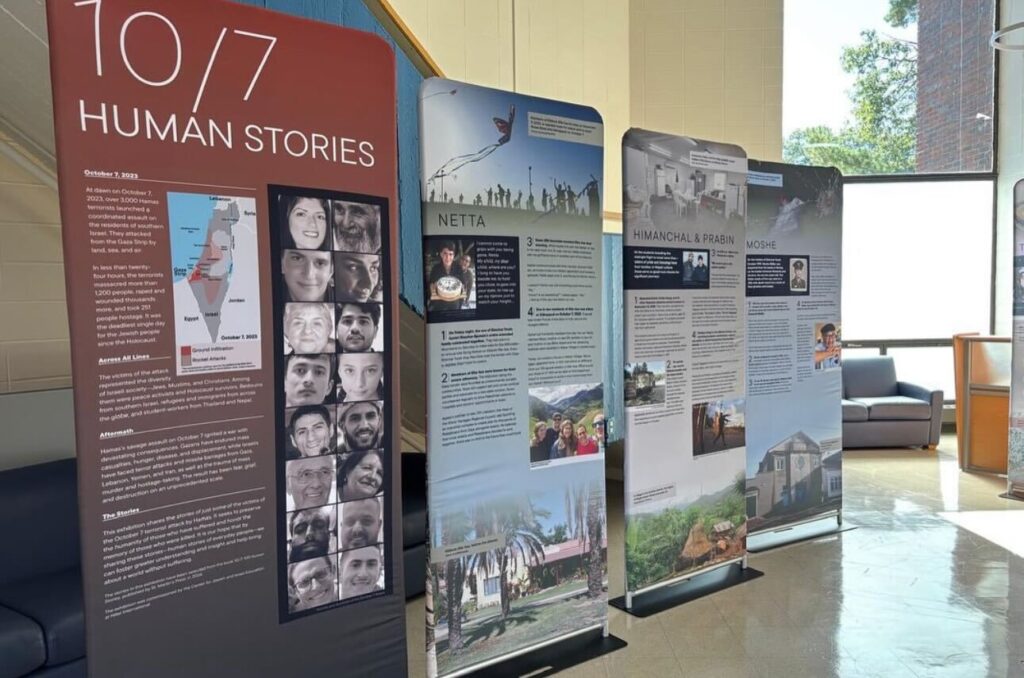
This fall, nearly two dozen Hillels across North America are hosting the exhibit “10/7: Human Stories,” developed by Hillel International and based on Israeli journalist Lee Yaron’s acclaimed book “10/7: 100 Human Stories,” to preserve the humanity of those who suffered and to honor the memory of those killed during the terror attacks on October 7, 2023.
The exhibit lifts up some of the lives lost, showcasing diverse stories of resilience and heroism, with the goal of providing high-quality educational programming about this defining moment in the contemporary Jewish and Israeli experience. As the exhibit’s introduction notes, it seeks “to preserve the humanity of those who suffered, and honor the memory of those who were killed… [so] that by sharing these stories — human stories of everyday people — we can foster greater understanding and insight and help bring about a world without suffering.”
“10/7: Human Stories” is displayed as a series of large visual panels, each one sharing the story of an individual or family impacted by the October 7 attacks. The written descriptions showcase the horrifying breadth of the violence — and the brutal aftermath.

But amid the horror and cruelty depicted, the power of human kindness, empathy, and compassion still shines through many of the stories. Six-year-old Romi and three-year-old Lia, sisters whose parents had just enough time to tell them to get out of their family car before they were killed by Hamas, were saved by a stranger’s kindness. The story of Celine, a young mother who was murdered at the Nova Music Festival on her last weekend of maternity leave, inspired women all around Israel to donate breast milk for her daughter Ellie.

At Northeastern University, students gathered in the sukkah – marking both Sukkot and the two-year commemoration of the attacks – for a remembrance ceremony before stepping among the exhibit’s panels. “With war still ongoing and hostages not yet home, we struggled with how best to mark this difficult date,” said Eitan Gitlin, Northeastern Hillel’s Israel engagement coordinator. “We decided to focus on the personal stories rather than the broader conflict. Our hope is that students will connect with the individuals whose lives were taken and honor their memory amidst all the noise surrounding Israel and the war.”
For Gitlin, the story that stood out to him most was that of Sujood and her husband Triffy, Muslim Bedouins from the village of Abu Karinat. On the morning of October 7, Sujood was in labor with their first child when Hamas terrorists on moving vans began shooting at their car. Sujood was struck twice in the abdomen, and rushed to the hospital for an emergency cesarean. Her newborn died later that day — but because the baby had protected her mother’s internal organs, Sujood survived. In October of 2024, Sujood gave birth to another daughter, who she named “Malak” (Arabic for “angel”).
“This is such a powerful story of strength, perseverance, and the resilience of the human spirit,” Gitlin said. A particularly moving part of Sujood’s story: Dr. Eyal Sheiner, the surgeon who delivered her first daughter on October 7, also delivered her second one year later.

The desire to connect to and center the humanity of the victims echoed across other campuses. Mike Steklof, executive director of Hillel of Buffalo, reflected, “[These stories] provide more than just facts; they offer a clear picture of how real people’s lives were impacted. By engaging with these personal narratives, students can move beyond headlines and statistics to truly understand the human experiences of those who lived and those who tragically lost their lives.” Buffalo Hillel built a month-long series of programs around the exhibit, including a day-long vigil and a discussion group featuring Lee Yaron, focusing on the book that inspired the panels.
Steklof was especially moved by the story of Himanchal Kattel and Prabin Dangi, Nepalese students in Israel as part of an exclusive university program, who had arrived in the country less than a month earlier. They survived the massacre, but 10 of their fellow students were killed, and one, Bipin Joshin, taken hostage. “Their story shows how the tragedy reached far beyond Israelis or Jews,” Steklof said.
For Naomi Fainchtein, associate director at American University Hillel, which will host the exhibit on October 16 (the day Israel observes its official national memorial for the attack), the panels are an answer to polarized campus debate. “So much of the conversation on campus, on social media, and in the news has decentered human experience and moved toward buzzwords, slogans, and arguments over facts,” she said. “This exhibit is a chance for our community to recenter around the real people, families, and communities that were forever impacted.”
At NYU’s Bronfman Center, more than 150 students are expected to attend the exhibit, which is on display for much of the month. “For our Hillel community, the exhibit evokes both grief and responsibility — the grief of remembering such a painful day and the responsibility to ensure these stories are heard and shared,” said Rabbi Emily Aronson. “The testimonies of families and young people… resonate deeply with us, reminding our students and staff alike of the importance of memory, witness, and collective responsibility.”

Temple University Hillel community engagement associate Brooke Singer also described feeling responsible for keeping these human stories alive. With the exhibit, which is being displayed in one of the largest rooms at the university before moving to the Hillel building, she hopes to showcase the “incredible things each and every one of these individuals did during some of the hardest moments in their lives.”
Across campuses from coast to coast, students are processing the stories in spaces where they can grieve, empathize, and reaffirm the Jewish commitment to honor every human being.
“This exhibit gives students a deeply personal way to connect with the events of October 7. We hope they gain empathy, understanding, and a sense of responsibility to remember and honor the lives lost,” said University of Wisconsin Hillel Jewish Agency Israel Fellow Rabeen Abu Hamid, himself from the Druze community in Israel.
May every memory, and every life, continue to be a blessing.