Hillel During the Firestorm: Shelter, Teacher, Negotiator
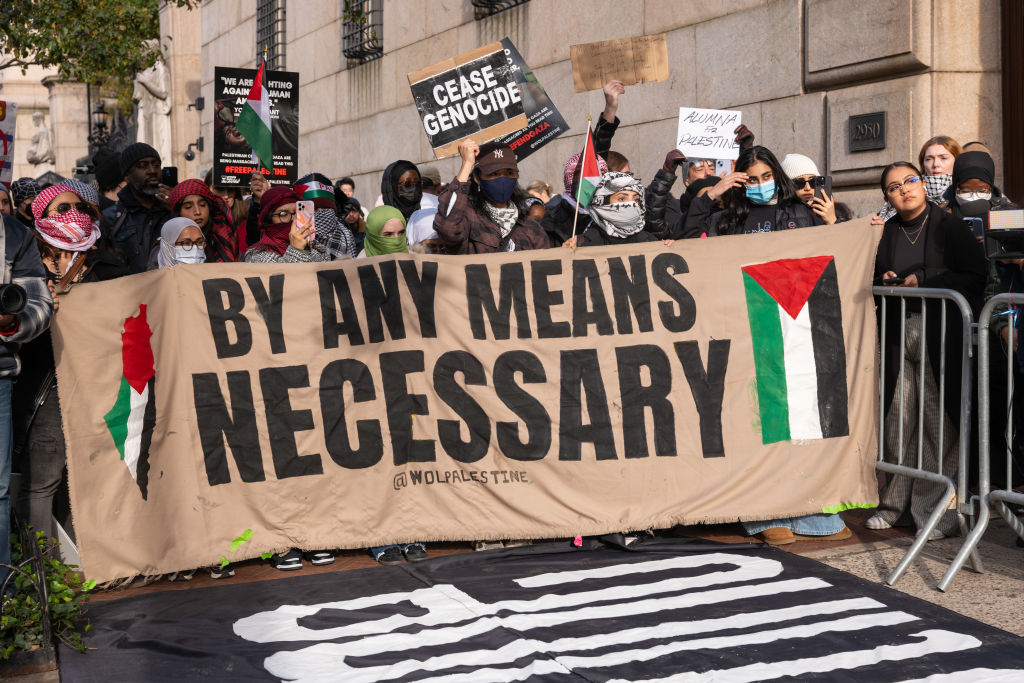
At Brown University, the executive director of Hillel received anonymous death threats. At Columbia University, the Kraft Center for Jewish Student Life was approached by protesters calling for Hillel’s removal. And at Harvard University, Jewish students entering Rosovsky Hall – home to Harvard Hillel – were greeted by chants of “Zionists are not welcome here.” The surge in antisemitism since the October 7, 2023 attacks has left many Jewish students feeling fearful and isolated. On college campuses, Hillel directors have stood squarely in the breach as educators, community-builders, and, at times, crisis managers.
Moderated by Rabbi Danielle Leshaw, Hillel International campus support director and senior educator, a recent conversation at The Temple Emanu-El’s Streicker Center in New York brought together five Hillel executive directors: Rabbi Josh Bolton (Brown RISD Hillel), Brian Cohen (Columbia/Barnard Hillel’s Kraft Center for Jewish Student Life), Jessica Lemons (Stony Brook Hillel), Rabbi Jason Rubenstein (Harvard Hillel), and Merav Fine Braun (Rita Levine Rabin Hillel at Hunter College).
Rabbi Leshaw framed the stakes clearly: even as eight in 10 Jewish students have experienced or witnessed antisemitism in the last two years, more than 187,000 students engaged with Hillel this past year, the most since Hillel’s founding in 1923. The crisis has also catalyzed a generation of Jewish students seeking deeper belonging, learning, and purpose.
“I’m going to go back before October 7th, and just share that Columbia University had one of the most vibrant, engaged, diverse Jewish communities,” said Brian Cohen. Then the campus environment shifted drastically. He added, “What I’m here to tell you, unfortunately, is that the encampments were the very tip of the iceberg. When you go under the surface and look at what too many students, faculty, and staff experienced, it was tokenization, exclusion, harassment, bullying, complete disregard for the rules of the university, and a complete disregard for just civility towards one another.” Safety came first. The university closed its gates to the public on October 12, 2023, something it had not done since September 11, 2001, amid surging demonstrations on and around campus.
“The second piece was just ensuring Jewish joy on campus,” Cohen said. An Israeli psychologist began holding weekly hours in the Hillel building, lowering barriers for students to seek support in Hebrew and English. Hillel hosted Israeli musician Ishay Ribo for a restorative concert. But Cohen also found himself in the role of advocate for Jewish students. “We asked people to reach out to the president’s office at Columbia and demand that the president meet with Jewish and Israeli students. The other piece is that we demanded that the rules be clarified and enforced,” he reflected.
At Hunter College, where the Jewish population includes Russian, Mizrahi, and Orthodox students, the students’ needs were different. As a commuter campus with 80% food insecurity among students, Hunter’s student needs are foundational and urgent. Fine Braun praised partners who backed concrete solutions. “We finally got kosher food at our cafeteria… but you can get it at Hunter Hillel for less… free if you need it to be free, but more if you want to pay,” she said. “Our campus, Hunter, was [also] the first to pioneer a full-time social worker on our campus, embedded in the Hillel. I’m deeply proud of this program. It has been life changing for our students, and it’s nationwide now and CUNY-wide now.”
The week after October 7, “We came into the Week of Rage, in which our entire school was cloaked in keffiyehs,” Fine Braun recalled. She wanted to remind students that Hillel would always be their home away from home. “I called 150 students that day. I made a video and I posted it on Instagram. And what I said in the video was, ‘I want you to remember that I love you and you’re beautiful, and you deserve to be here, and your joy matters. So come to Hillel.’”
For Stony Brook Hillel’s Jessica Lemons, the moment that changed everything came in a phone call from campus police. “They asked me if we needed extra security,” she remembered. “And I asked them why? What should I know that you know? And they said, ‘Do you know what’s happening in Israel?’” That call was emblematic of the relationships Stony Brook had already built. “Prior to October 7th, we actually had an antisemitism task force already in place,” Lemons said.
The first year was bruising: encampments, two rounds of arrests, harassment of visibly Jewish students, and even Lemons’ car being keyed. Then, according to Lemons, their administration said, “Don’t get comfortable, don’t relax, because we’ve got work to do.” They mapped policies for every scenario, clarified procedures, trained faculty and staff on Title VI of the Civil Rights Act, and met regularly with SUNY leadership. “We saw a 90% decrease in reported antisemitic incidents from the 2023-2024 academic year to the following year,” Lemons reported. “I think it is really indicative of the fact that when you make policies and you actually stick to the consequences that you’ve articulated to students, faculty, and staff, it actually makes a big difference.”
In Providence, Rhode Island, Rabbi Josh Bolton described a Brown University campus that is “quieter than a year ago,” yet still shaped by deeper currents that erupted after October 7th. He sees students turning to Jewish life not only for refuge but for meaning. Engagement is strong, and students are creating new initiatives, especially in the arts. Last year, amid divestment debates, Brown RISD Hillel adopted a refrain rooted in pragmatic joy. Rabbi Bolton said, “When the calls are made to divest, we believe that this is a time to invest strongly in the future of Jewish life on campus.” Still, Rabbi Bolton warned that anti-Zionist and antisemitic rhetoric is entrenched in the broader university culture, a phenomenon that won’t change overnight. “What are the long-term models that we’re going to use and employ in order to begin to dial that culture in a different direction,” he said.
At Harvard, Rabbi Jason Rubenstein urged his community to broaden their approach to antisemitism. “We’ve primarily defaulted to a framework of, ‘Are Jewish students safe?’ [But there can also be] a major problem for the Jewish community, even if there are no Jewish students in that seminar room,” he shared. He described a culture where “it’s kind of axiomatic that Israel is evil, maybe the paradigm of evil.” Rabbi Rubenstein has focused on helping alumni become “informed, cohesive, and effective,” coordinating messages and relationships — including with Harvard governance stakeholders — so change happens at the level that endures.
Across their differences, a shared picture emerges where Hillel directors became crisis responders and spiritual counselors, policy partners and culture builders, sometimes all in the same day. As Rabbi Danielle Leshaw noted, the numbers tell only part of the story. The rest is found in the leaders who refused to let fear define Jewish life for their students, and who insisted, in every language available, that Jewish belonging, learning, and love still have a home on campus.