How a Hillel Can Be a Sukkah for Jewish Students
Rabbi Josh Lobel is the Reform rabbi and senior director of Jewish Life and Learning at Rutgers Hillel.
Warm and welcoming. Inclusive. Pluralistic. Open to all. These words are often at the heart of Hillel’s programming around the world, where creating a sense of belonging and acceptance is an essential value. And there is no better time to demonstrate this value than during the festival of Sukkot.
One of the many names for Sukkot is Chag Ha’Asif, the Festival of Ingathering. This name is rooted in the origins of this joyful holiday as an agricultural festival, an opportunity to celebrate the harvest. However, as we prepare to celebrate Sukkot, I’d like to reflect on a different kind of “gathering.”
During the festival of Sukkot, we pick up the lulav, which combines a palm frond, myrtle, and willow, along with an etrog, a fragrant yellow citron, and wave them in all directions, symbolizing the omnipresence of the Divine. Jewish tradition teaches us that these four components represent four different kinds of people.
The myrtle has a lovely smell but no taste, representing individuals who perform good deeds, but lack deep knowledge. Date palms produce dates with a sweet taste but no inherent smell, representing those who may be brilliant but don’t use their knowledge to do good in the world. The etrog, the ideal, possesses both taste and smell, symbolizing people who are blessed with wisdom and a kind heart, while the willow represents those who, maybe at the moment, lack both.
Sukkot calls us all to join together in one bundle of belonging. Like the elements of the lulav, the Jewish people are not complete without scholars, givers, mentsches, and works in progress. Everyone is welcome underneath the shelter of the sukkah.
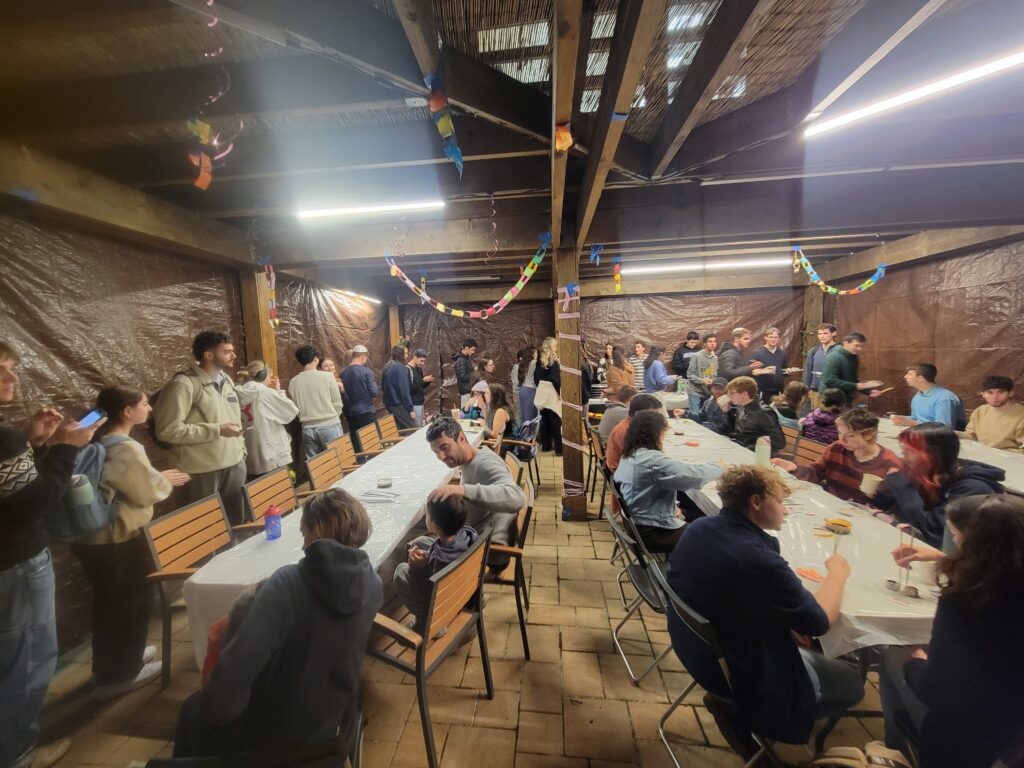
At Rutgers Hillel, the values of inclusion and pluralism are at the center of our Sukkot celebration. Student representatives from all areas of Jewish life come together before the holiday to plan and promote our “Sushi in the Sukkah” experience, inviting everyone for a tasty treat, good music, and camaraderie. It is a student-driven event, with our student leaders owning all aspects of the experience with a sense of intentionality and purpose.
Often at our Hillel, we hold events for specific groups based on identity or affinity, but “Sushi in the Sukkah” transcends those differences. We see Orthodox students mingling with secular Jews, and theater kids conversing with Greek life members. It is a highlight of our year.
Like the components of the lulav, Jewish students at Hillel are diverse, with unique backgrounds, qualities, and interests. We do not seek conformity. Rather, we embrace a multiplicity of perspectives about what it means to live an authentic Jewish life. Recognizing that we run the gamut when it comes to Jewish expression provides us with a tremendous opportunity, even responsibility, to create moments for relationship-building among people of different backgrounds.
As a Hillel, we want to be a safe place where everyone feels accepted and cherished, and we also must seize moments when our students can broaden their perspectives and meet people outside their circles. Sukkot is such a time, as we not only build our physical sukkah, but also, through the openness and nature of the sukkah, expand our conception of what it means to be welcoming and pluralistic. When we work together to bring all our students under the shelter of a Hillel sukkah, it is indeed a z’man simchateinu, a time to rejoice.