Lessons from Shavuot: Finding a Path Through the Wilderness
“May I be empty
and open to receive the light
May I be empty
and open to receive
May I be full
and open to receive the light
May I be full
and open to receive”
Batya Levine, “May I be Empty”
The holiday of Shavuot celebrates a moment of receiving. After wandering through the vast, empty desert, the Israelites arrived at Mount Sinai to receive the Torah — the great revelation after liberation, the moment our tribes became a people.
The commentaries on this moment are remarkable for how broadly they describe the receiving of the Torah.
- The Midrash Tanchuma teaches that the Torah was given in the wilderness because “just as the wilderness is ownerless, available to all, so too the words of Torah are ownerless, available to all.”
- Another midrashic text, Shemot Rabbah, goes further, teaching that “not only those who were in the wilderness stood at Sinai, but also the souls of all future generations.”
- The 19th-century Hasidic master Sefat Emet wrote that the divine voice was heard differently by each person, “according to their capacity,” and that the giving of Torah was both a singular moment and an ongoing, living one.
Together, these teachings say something radical: we were all there. Each of us received a message that was both personal and communal, belonging not to one person or one group, but to all of us, for all time. And each time we interpret, innovate, or uncover something new from within our tradition, we become part of the great unfolding story of Sinai.
I’ve been thinking about this a lot lately, in conversations with graduating seniors facing what I can only describe as their own wilderness: the uncertainty of life after college.
A memory from my own time of wandering keeps coming back to me.
In June 2008, I had just finished a master’s degree in history at UC Santa Cruz. My plan had been to pursue a PhD and become an academic historian. But somewhere along the way, it became clear that wasn’t the right path. I didn’t know what else to do, and I was terrified. I was applying for jobs frantically, feeling lost in that wilderness, my story wide open.
Around that same time, a beloved rabbi was leaving Santa Cruz Hillel, where I’d been involved throughout my time as an undergrad and in graduate school. A committee asked me to help with the search for a new staff member.
Then, after we’d interviewed a couple of candidates, one of the committee members turned to me and said, “Heather, why haven’t you applied for this position?”
It was my Sinai moment — a moment of personal revelation within the communal.
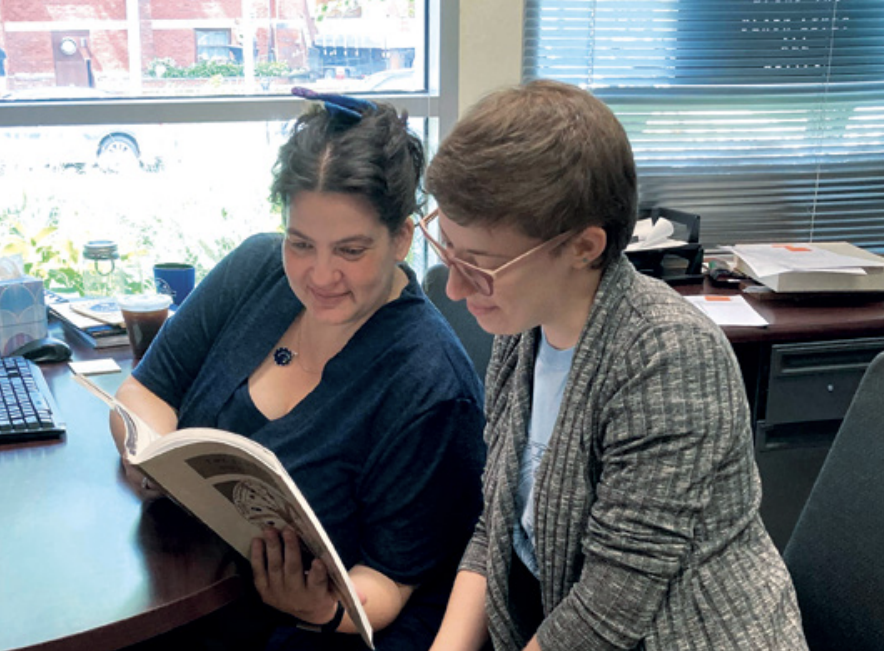
I had never considered working for Hillel. But the more I sat with the question, the better it felt. Hillel had always been a reliable, loving space for me, no matter what else was happening in my life. Why not give back to something that had given me so much, and create that kind of space for others? When I look back now, I realize that Hillel was also there for me in that moment, offering a path forward.
Like Moses at the burning bush, it wasn’t just that I happened to be in the wilderness. I had to have the courage to own the uncertainty before the path forward could reveal itself.
That was 18 years ago. I’m still working for Hillel, now as a rabbi, a teacher of Torah.
This story has become part of my own Torah, a moment I return to when I’m facing a new wilderness, or sitting with a student who is facing theirs. When we’re feeling lost, it’s tempting to narrow our vision, to reach for the familiar because the unknown is frightening. But Shavuot reminds us that we are all standing at Sinai, each receiving the divine voice according to our own capacity. Sometimes it arrives through a friend or mentor who sees something in us we couldn’t see in ourselves.
As Reb Zalman Schachter-Shalomi z”l taught, the divine broadcast is eternal; “the question is whether we have our receivers turned on and tuned to the right frequency.”
The Kabbalists also taught us to read the Hebrew word “midbar,” wilderness, as “midaber,” to speak, to tell, to create worlds with our words. Revelation is not only about what we receive. It’s about how we respond.
Many of my students, especially the graduating seniors, are standing in their own wilderness right now. With Shavuot approaching, I encourage all of you to tune in. Notice who is standing with you at Sinai. Open yourself to whatever message comes through. Torah belongs to all of us, and the messages and the teachings are still guiding each of us through our own personal and shared wilderness.
What is the message meant for you? And what will you do when you receive it?
Rabbi Heather Paul is the senior Jewish educator at Illini Hillel.